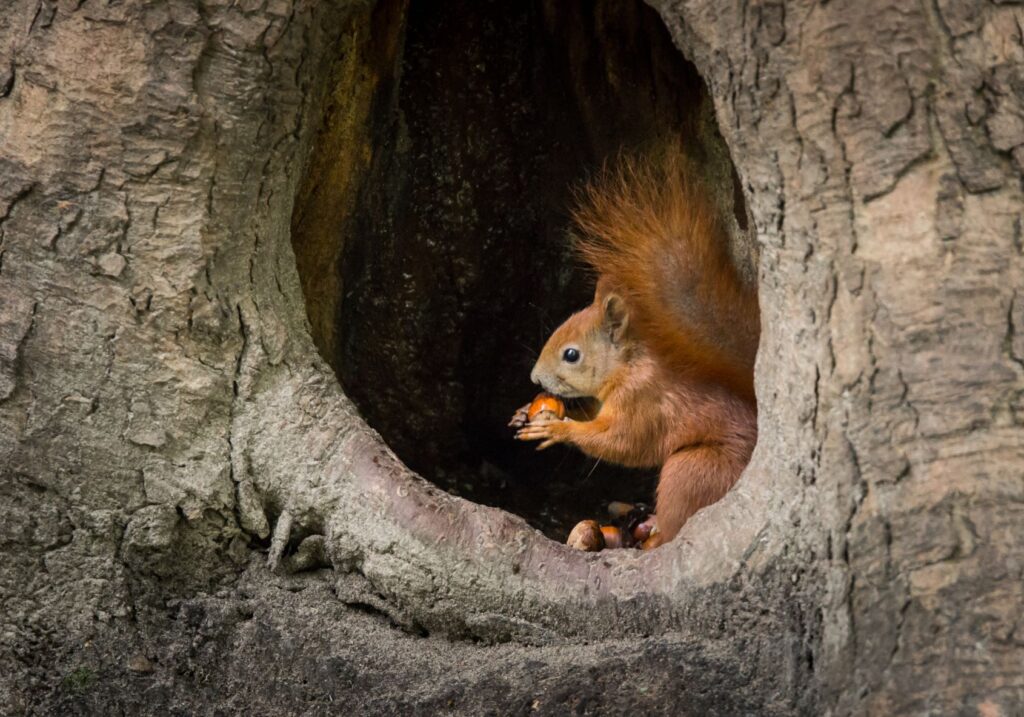
Guidelines need to be followed to avoid inadvertent red squirrel killings
PRESS RELEASE
02/10/2025
Timber harvesting systems more sympathetic to red squirrels must be adopted
Concerns are being raised that the failure to adopt Forestry Commission guidelines for timber harvesting, in woodland supporting red squirrels, is having a devastating impact on populations of the highly protected species, particularly during the breeding season.
The European Squirrel Initiative (ESI), a charity committed to securing the future of the red squirrel, has queried whether guidance measures it helped to create and that were published over two years ago, are being followed rigorously in areas where red squirrel populations are present.
The ESI worked with the Forestry Commission and the UK Squirrel Accord, alongside other conservationists, over a period of some nine months to draw up new guidance, published by the Commission in March 2023, on how to plan and carry out forestry operations, so as to minimise impacts on red squirrels.
The guidelines advise that surveys should be conducted before any harvesting, to detect red squirrels and locate active dreys, and to avoid felling in red squirrel areas during the breeding season, with the period between February and September identified as when most disturbance is likely.
It also states that operatives should be trained and instructed to look for dreys and red squirrels during operations. If active dreys are found, work should be halted or moved to avoid those trees.
However, in Northumberland, an area very much in the front line of red squirrel conservation, concerns have been raised that timber harvesting operations had been taking place on a Forestry England site (Ouseburn) in late July and August, when red squirrel kits were both active, and vulnerable.
The ESI fears that the young red squirrel kits in this area will have had little chance of survival from disturbance from these harvesting operations.
“We at the ESI have spent a great deal of time researching and coming up with operational checklists and best practice to help improve timber harvesting in red squirrel areas,” says ESI vice-chairman and chartered forester Charles Dutton.
“The red squirrels are a protected species, and it would be deeply concerning if it transpired that any state-run timber harvesting operations were not following their own guidelines,” he adds.
Disturbance from timber harvesting operations is not only a localised issue for red squirrel populations. The issue is in fact a worldwide concern, with similar problems affecting koalas in Australia, and the Siberian flying squirrel in Finland, where Aspen trees are harvested.
Mr Dutton explains that much of his research in this area, and that of the ESI, has drawn on the work of the pioneering ecologist Sir Frank Fraser-Darling. As an agricultural adviser in the Highlands and Islands in the 1950s and 1960s, he had worked to save the ground-nesting corncrake from decline, by adjusting and influencing changes to modern farming practices to help support the bird’s nesting habitat.
For the red squirrel populations, Mr Dutton has advocated a similar change in mind-set with timber harvesting enterprises, and by following the Forestry Commission guidelines, it is possible to minimise the impact on red squirrels.
“It is crucial that these enterprises follow the guidelines set out by the Forestry Commission if we are to support red squirrel conservation in vital areas such as Northumberland, establishing harvesting systems that are more sympathetic to our red squirrel populations,” he concludes.